 The Green Post Ireland
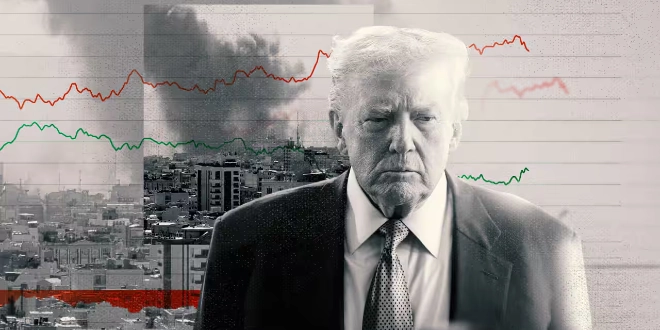
US President Donald Trump said the United States and Israel are in a strong position in their war against Iran, vowing that the joint campaign would continue as the conflict entered its fifth day.
Speaking at the White House, Trump said the military operation was progressing better than expected and claimed Iran’s leadership and military capabilities were being rapidly dismantled.
“We’re doing well on the war front, to put it mildly,” Trump told an audience of technology executives. “On a scale of 10, I’d say about a 15.”
Iranian Military Capabilities Under Heavy Attack
Trump said Iran’s ballistic missile arsenal was being destroyed quickly as part of the ongoing campaign.
He repeated his argument that the strikes were necessary to stop Tehran from developing nuclear weapons.
“When crazy people have nuclear weapons, bad things happen,” he said.
The US-Israeli offensive began with a wave of coordinated strikes that reportedly killed Iranian Supreme Leader Ayatollah Ali Khamenei along with several senior political and military figures.
US Submarine Sinks Iranian Warship
The conflict intensified further after a US submarine sank an Iranian warship off the coast of Sri Lanka.
US Defence Secretary Pete Hegseth confirmed the attack, saying the vessel was destroyed by a torpedo while operating in international waters.
According to officials, at least 87 Iranian sailors were killed and dozens more remain missing after the ship sank near the southern Sri Lankan city of Galle.
It marks the first time since World War II that the United States has sunk an enemy warship using a torpedo.
Footage released by the US Department of Defense later showed what officials said was the moment the vessel was destroyed.
Questions Over Post-War Strategy
Despite the strong rhetoric from Washington, the Trump administration has not outlined a clear plan for what happens once the fighting ends.
The White House said Iran’s clerical government was being “absolutely crushed” but declined to confirm whether the United States aims to force regime change in Tehran.
Press Secretary Karoline Leavitt said Trump is “actively considering” the future role of the United States in Iran after the war concludes.
She also rejected reports that Washington had agreed to arm Kurdish militias inside Iran to trigger an internal uprising, though she confirmed the president had spoken with Kurdish leaders.
Succession Question After Khamenei
Attention has now shifted to the question of Iran’s next leader.
Sources in Iran say Mojtaba Khamenei, the son of the late supreme leader, is alive and could emerge as a leading candidate to succeed his father.
Iran’s Assembly of Experts is expected to decide on the new supreme leader soon — only the second leadership transition since the Islamic Republic was founded in 1979.
Israel has already warned that whoever replaces Khamenei could also become a target if hostilities continue.
Civilian Deaths Spark International Concern
International concern has grown over reports of civilian casualties.
A United Nations panel said it was “deeply disturbed” by the deaths of children during an airstrike on a girls’ school in southern Iran on the first day of the conflict.
Iranian authorities say more than 1,000 people have been killed in US-Israeli strikes so far, including 165 girls in the school bombing.
US and Israeli officials have said they are investigating the incident.
Conflict Expands Beyond Iran
The war has already spread across the wider Middle East.
Iran’s Revolutionary Guards say they now control the Strait of Hormuz, a critical shipping route through which around one-fifth of global oil supplies pass.
Israel has also expanded operations into Lebanon, ordering residents in southern regions to evacuate north of the Litani River while continuing strikes on Hezbollah targets.
Lebanese authorities say more than 83,000 people have been displaced and at least 72 people killed since Israeli attacks intensified earlier this week.
With missile strikes, naval battles and regional militias entering the conflict, the war is rapidly expanding across the Middle East — raising fears of a prolonged and potentially wider regional confrontation.