 The Green Post Ireland
At least 31 people have been killed and 80 others injured after two passenger trains collided in central Spain on Wednesday, October 28, in the country’s second major fatal rail disaster in less than a year.
The collision involved trains operated by Renfe and Iryo near the municipality of Urda in Castilla-La Mancha, along the high-speed railway connecting Madrid with the southern Andalusia region.
Emergency services launched a major rescue operation as authorities suspended rail traffic on the affected route.
Renfe and Iryo Trains Collide Near Urda
The crash occurred shortly after 9am local time, according to regional authorities.
A person briefed on the incident said an Iryo express train had stopped at a signal when it was struck by a Renfe high-speed train.
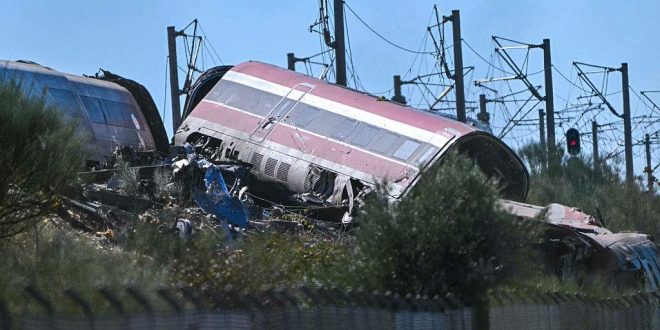
The impact caused two Iryo carriages to derail.
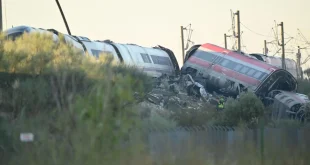
Footage broadcast by Castilla-La Mancha Television showed extensive wreckage, including damaged carriages and debris scattered along an embankment beneath an elevated section of railway.
Regional government spokesperson Esther Padilla said 147 passengers were travelling on the Iryo train and 397 on the Renfe service.
Rescue Teams Search for Survivors
Emergency responders, including police, ambulances and helicopter crews, were deployed to the crash site.
Authorities continued searching the damaged trains for survivors as the reported death toll reached 31.
Manuel Galán, mayor of nearby Urda, said emergency services had asked local officials to prepare facilities, including a sports hall, to accommodate passengers and injured people.
A passenger identified as Miguel told COPE radio that he heard a tremendous impact lasting several seconds before seeing a badly damaged train through the window.
Another passenger, Eduarda, told Cadena SER that she was thrown forward by the collision and initially believed the train had made an emergency stop.
After evacuating down an embankment, she described seeing severely damaged carriages, a fire and fatalities at the scene.
Madrid-Andalusia High-Speed Rail Services Suspended
Spain’s railway infrastructure operator Adif confirmed that traffic on the Madrid-Andalusia high-speed line had been suspended following the rear-end collision.
Renfe activated a dedicated assistance line for victims’ families and expressed condolences, while Iryo said its emergency procedures had been activated.
The duration of the disruption was not immediately clear.
Pedro Sánchez Expresses Shock Over Fatal Crash
Spanish Prime Minister Pedro Sánchez said he was shocked by the disaster and offered solidarity and support to those affected.
His official schedule was cleared for the day following the collision.
Spain’s opposition People’s Party also cancelled campaign events as the country responded to the tragedy.
Second Deadly Train Collision in Nine Months
Wednesday’s crash comes approximately nine months after another serious accident involving Renfe and Iryo trains on the Madrid-Andalusia route.
In January 2026, a train derailed near Adamuz in Córdoba province and collided with an oncoming service, killing 46 people.
That disaster prompted questions about railway infrastructure maintenance and investment.
The latest collision is likely to renew scrutiny of Spain’s high-speed railway network, although investigators have not yet established the cause of Wednesday’s crash.
Railway Safety and Maintenance Under Scrutiny
Figures from Spain’s railway safety authority show that reported railway accidents, including collisions and derailments, increased from 45 in 2016 to 57 in 2024 and 69 in 2025.
European Commission data cited in the report indicates that Spain invested an average of approximately €1.5 billion annually in its high-speed rail network between 2018 and 2022.
However, only around 16% of that spending was allocated to maintenance, renewal and upgrades, with most funding directed towards new infrastructure.
Spain operates roughly 4,000 kilometres of high-speed railway lines, among the largest networks in Europe.
Despite concerns about investment priorities, European railway data has historically placed Spain among countries with relatively low rail fatality rates.
Investigation Into Cause of Collision Awaited
Authorities had not announced a definitive cause of the crash at the time of the initial report.
Investigators will need to establish the sequence of events leading to the collision, including why the two trains were on the same section of track and whether signalling or operational factors played a role.
With rescue operations continuing, the reported casualty figures may change as further information becomes available.