 The Green Post Ireland
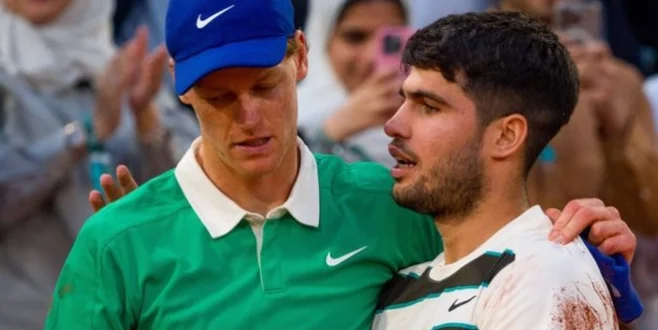
Indian Wells hard courts play slower than most ATP hard events, so the underdog often gets a few more neutral balls—but that also means elite returners can squeeze service games until breaks feel inevitable.
This matchup is defined by scale: Sinner’s typical hard-court profile sits in an upper-80s hold% range with a mid-to-high 20s break%, while Svrcina projects closer to a mid-70s hold% with a low-20s break% at best at this level.
Expect a match where duration depends less on “who wins” and more on whether Svrcina can hold once per set without bleeding repeated break points.
Measurable comparison table
| Metric | Dalibor Svrcina | Jannik Sinner |
|---|---|---|
| Hold % (Surface) | 76% | 88% |
| Break % (Surface) | 21% | 28% |
| First Serve Win % | 69% | 75% |
| Avg Match Duration (Last 5) | ~112 min | ~97 min |
| Break Points Saved % | 57% | 66% |
| Surface Win Rate (Hard, last 12 months) | 53% | 79% |
Surface angle: Indian Wells “slow hard” cuts both ways
The common trap is assuming slow hard automatically helps the underdog. It can, but only if the underdog can protect second serve and keep rallies from turning into repeatable patterns.
- For Sinner, slow hard is a multiplier for his core strength: depth + pace tolerance. He doesn’t need aces to dominate; he needs two or three high-quality returns per set to create scoreboard pressure.
- For Svrcina, slow hard gives more looks in rallies, but it also raises the tax on any short ball. If his average rally ball lands shorter under pressure, Sinner’s first-strike patterns (especially off the backhand line) will convert neutral points into immediate defense.
Net: the surface reduces “random ace holds,” which usually favors the elite returner.
Tactical matchup: where Svrcina can actually compete
Svrcina’s best chance is not to “out-hit” Sinner, but to win specific micro-battles:
- First-serve placement > speed: He needs cheap points through location, not power. If first-serve points won dips below the high-60s, his hold probability collapses quickly.
- Two-shot discipline on return games: He doesn’t need many breaks—he needs to avoid wasting the few 0–30 or 15–30 looks he might get. If Sinner’s first-serve percentage wobbles early, that’s the only realistic window to steal momentum.
- Avoid the deuce spiral: Against elite return pressure, one extra backhand error can turn a comfortable 40–15 into a break. Svrcina’s goal is to keep service games out of the “two deuces” zone where Sinner’s return depth usually wins.
Implied probability vs estimated probability
In matches like this, the market typically implies a very high favorite probability (often 90%+ for the top player) and makes the moneyline close to unusable for value.
My estimated probability:
- Sinner: 92%
- Svrcina: 8%
That estimate still leaves a small upset tail (tennis variance exists), but it strongly suggests the actionable angle is spread/total, not side, unless you find an unusually generous price on the underdog.
Macro tournament context: Masters 1000 draw pressure
This is a Round of 32 at a Masters 1000: ranking points and narrative pressure are real, especially for the elite player expected to go deep. The favorite’s incentive is to keep the match short and reduce physical cost; the underdog’s incentive is to extend, frustrate, and force extra shots. Indian Wells conditions can add wind and slower timing, which occasionally creates early-set wobble—but elite baseliners usually stabilize after 3–4 games.
Variance risk disclosure
- Break-point volatility: If Svrcina faces repeated break points early, a single saved-break “swing game” can inflate totals even in a straight-sets loss.
- Serve dip: If Sinner’s first-serve percentage is unusually low, Svrcina can hang around longer than the talent gap suggests (more second serves, more rallies, more deuce games).
- Fatigue collapse: The underdog is more exposed here—if Svrcina plays multiple long return games and then has to defend deuce-heavy service games, the second set can snowball fast after one physical drop.
Edge strength indicator
Moderate — not on the match winner, but on the market angle: you’re choosing between “Sinner covers comfortably” versus “slow hard inflates games even in a mismatch,” and that’s where a misprice can exist.
Expert signature
Mismatch matches are rarely about genius picks; they’re about choosing the right container for variance. Against an elite returner on slow hard, the underdog’s biggest weapon is not winners—it’s resisting the first break long enough to push sets into 4–4/5–5 territory. If that doesn’t happen early, the match can compress rapidly.
Final Projection
Final Prediction: Sinner wins comfortably (straight sets most likely)
Best Bet: Sinner -5.5 games (only if the line isn’t fully “taxed” by public favorite pricing)
(Optional Alternative): Under 19.5 games if conditions look calm and Svrcina’s second serve is immediately under heavy pressure