 The Green Post Ireland
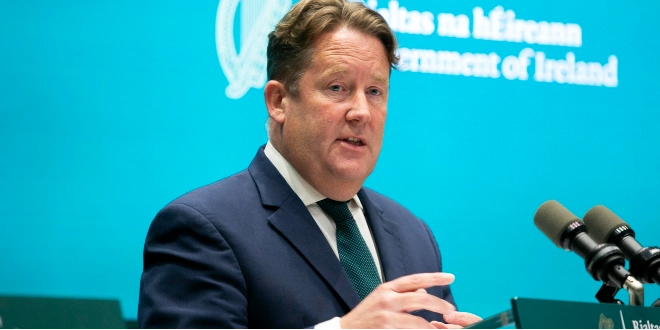
Legislation to remove the long-standing passenger cap at Dublin Airport is set to be discussed at this morning’s Cabinet meeting, marking a significant policy step for Ireland’s busiest transport hub.
Dublin Airport passenger cap legislation moves forward
Minister for Transport Darragh O’Brien will ask Cabinet colleagues to approve the drafting of the Dublin Airport Passenger Capacity Bill. Based on a general scheme already prepared, the legislation would give the minister the authority to revoke or amend the existing 32 million passenger limit and prevent any future cap from being imposed.
The passenger cap was originally introduced in 2007 as a planning condition linked to the approval of Terminal 2. At the time, the airport handled around 23 million passengers annually. Since then, air travel has expanded sharply, with passenger numbers now exceeding the 32 million threshold.
Although the cap remains formally in place, it is not currently being enforced. The High Court has referred legal challenges brought by several airlines to the European courts, effectively suspending its implementation. Removing the cap is also a stated commitment in the current Programme for Government, agreed by coalition partners.
The Minister expects the legislation to be passed later this year, even though daa’s separate infrastructure application to Fingal County Council references a potential passenger ceiling of 40 million. That planning application also includes proposals for new aircraft stands, expanded aprons, improved access routes, additional car parking and other structural upgrades, and there are no plans to withdraw it at this stage.
Defence Forces modernisation update
Cabinet will also receive an update on progress in implementing the recommendations of the Commission on the Defence Forces. The reforms are aimed at modernising and re-equipping the Army, Naval Service and Air Corps.
Minister for Defence Helen McEntee is expected to outline a new strategic plan focused on boosting recruitment and retention, improving equipment and working conditions, revitalising the Reserve Defence Force and advancing legislative reforms designed to strengthen Ireland’s defence capability.
Living City Initiative expansion
Minister for Finance Simon Harris will present plans to extend the Living City Initiative to additional towns across the country. The scheme allows property owners to claim tax relief on the refurbishment or conversion of residential and commercial buildings, encouraging them to be brought back into active use.
Currently limited to Dublin, Cork, Galway, Limerick and Waterford, the initiative will now be expanded to Athlone, Sligo, Letterkenny, Drogheda and Dundalk. The scheme will also be extended until 2030 as part of broader efforts to tackle dereliction, vacancy and urban decline.
Arts income scheme and policing cooperation
Minister for Culture, Communications and Sport Patrick O’Donovan will brief Cabinet on developments in the Basic Income for the Arts scheme. The programme provides a weekly payment of €325 to selected artists and was first launched in 2022, when 8,000 people applied and 2,000 were chosen at random to receive support.
Minister for Justice Jim O’Callaghan will also seek approval for An Garda Síochána to enter into a formal cooperation and information-sharing agreement with Colombia’s National Police. Ireland already has a Garda liaison officer based at the Irish Embassy in Colombia, and the agreement is intended to strengthen efforts to combat transnational crime and terrorism through closer international collaboration.
Infrastructure approvals to be accelerated
Minister for Public Expenditure Jack Chambers will outline new measures designed to speed up the delivery of major transport, energy and water projects. Under the proposed changes, large investments valued between €200 million and €500 million will no longer require early-stage approval by external consultants.
Instead, assessments will be carried out directly by the Department of Public Expenditure and Reform, a move expected to cut approval timelines by up to 20 weeks. At later stages, some projects will also be able to proceed without direct ministerial sign-off, relying instead on approval from the relevant departmental accounting officer.
These changes form part of a wider push by the Government to accelerate infrastructure delivery. Other recent measures include a review of legal fees in environmental cases and the expansion of the National Development Finance Agency to support faster implementation of major capital projects.
Taken together, today’s Cabinet agenda reflects a broad effort to remove bottlenecks, support growth, and modernise key sectors ranging from aviation and defence to housing, culture and national infrastructure.