 The Green Post Ireland
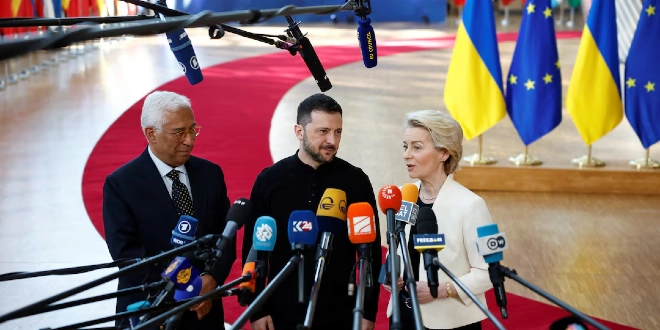
European Union leaders have agreed to raise a €90 billion loan to support Ukraine over the next two years, providing Kyiv with a crucial financial lifeline while postponing a more controversial plan to directly leverage frozen Russian assets. The decision was finalised in Brussels in the early hours following prolonged negotiations that exposed divisions over legal risk and long-term guarantees.
While the agreement ensures funding for Ukraine through 2026 and 2027, EU leaders ultimately declined to adopt a proposal that would have used tens of billions of euros in immobilised Russian assets as the foundation for a longer-term support mechanism. The compromise reflects both urgency over Ukraine’s financial needs and lingering concerns about legal exposure within the bloc.
Legal concerns derail Russian asset proposal
Belgium, which hosts the vast majority of frozen Russian assets through the financial services company Euroclear, played a central role in the debate. Belgian officials sought firm, open-ended guarantees that their country would not be held financially responsible if Russia were to succeed in a legal challenge against the use of those assets.
As talks progressed, technical teams worked intensively to design safeguards in what EU officials described as a highly unlikely scenario: Russia winning an international arbitration case that could be enforced within the European Union. Despite these efforts, no solution proved acceptable to all parties by late evening.
With time running out, leaders revived an alternative option that had initially appeared politically difficult — issuing joint EU debt backed by unused funds in the bloc’s seven-year budget. This approach required unanimous support, but several member states often viewed as sympathetic to Moscow, including Hungary, Slovakia and the Czech Republic, agreed not to block the move provided they were not directly involved in the joint borrowing.
Funding secured as pressure mounts on Kyiv
Under the final agreement, EU leaders stressed that Russian assets would remain frozen. They also stated that if Russia refuses to pay reparations in a post-war settlement, those assets could ultimately be used by Ukraine to repay the EU loan, keeping the door open to future action without immediate legal risk.
The deal follows more than a full day of negotiations at a European Council summit and comes as Ukraine faces mounting financial strain. EU estimates suggest Kyiv needs an additional €135 billion over the next two years, with a cash shortfall expected to emerge as early as April.
European Council President Antonio Costa confirmed the outcome on social media, writing that a decision had been approved to provide €90 billion in support for Ukraine over 2026–27. German Chancellor Friedrich Merz, who had strongly supported using Russian assets, said the agreement still sent a clear message to Russian President Vladimir Putin about Europe’s commitment.
Ukrainian President Volodymyr Zelensky welcomed the decision, thanking EU leaders for what he described as meaningful and timely support. He said the funding would strengthen Ukraine’s resilience and stressed the importance of keeping Russian assets immobilised as a form of financial security for the future.
Earlier in the summit, Zelensky had urged EU leaders to take the bolder step of using Russian assets directly, arguing that doing so would be morally justified, legally sound, and appropriate given the destruction caused by Russia’s invasion. While Kyiv may be disappointed that this option was deferred, securing funding through other means still offers significant relief.
War talks and US pressure in the background
The EU’s decision comes against the backdrop of renewed US efforts to push for a negotiated end to the war. Zelensky told EU leaders that Ukraine needed clarity on future security guarantees and said that stabilising the country’s finances could strengthen its position in any peace talks.
Ukraine and the United States are set to hold further discussions in Washington over the coming days, with Zelensky pressing for clearer commitments on how Ukraine would be protected from renewed aggression. He questioned what concrete guarantees the US could offer and how they would function in practice.
US President Donald Trump has continued to urge Kyiv to move quickly toward a deal, warning that delays could shift Moscow’s stance. Russia has yet to formally respond to the latest EU funding decision, and President Vladimir Putin has reiterated that the Kremlin intends to pursue its maximalist objectives in Ukraine.
While both Ukraine and the United States say progress has been made on future security arrangements, significant disagreements remain, particularly over territory. For now, the EU’s €90 billion loan provides Ukraine with much-needed financial stability as diplomatic and military uncertainties continue to loom.